top of page


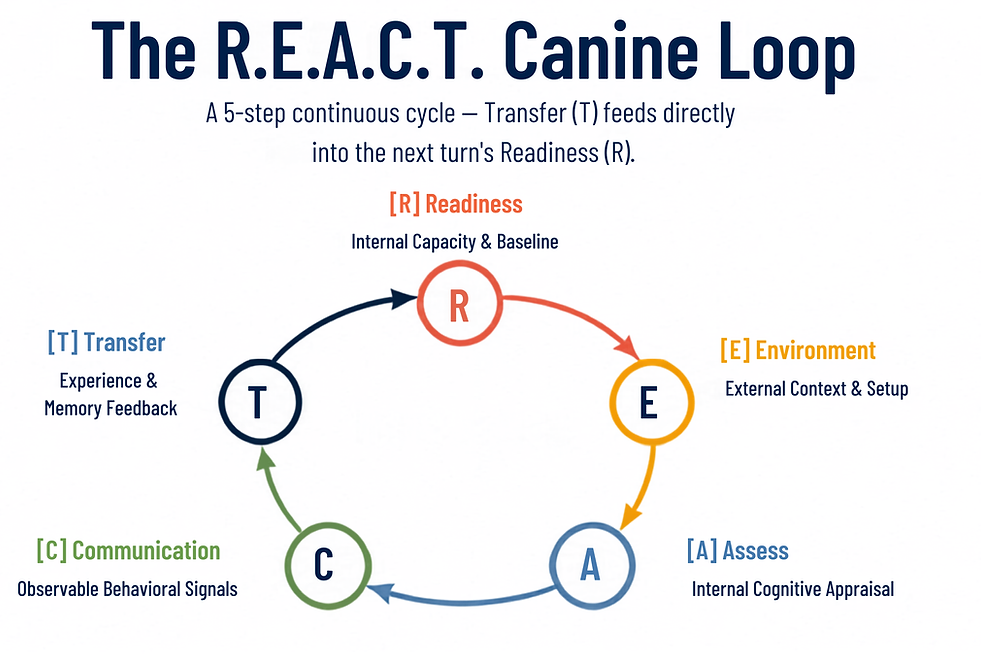
The R.E.A.C.T. Canine Loop: A Framework for Understanding Dog Behavior
What Is the R.E.A.C.T. Canine Loop?
The R.E.A.C.T. Canine Loop is a five-part framework for understanding why dogs behave the way they do, developed by [Author Name] through years of force-free behavior consulting. R.E.A.C.T. stands for Readiness, Environment, Assess, Communication, and Transfer — five interconnected stages that describe how a dog moves from an internal biological state, through a triggering situation, to a visible behavior, and finally to an outcome that shapes tomorrow’s baseline.
The core idea behind the loop is simple but often overlooked: behavior is never random, and it is never a moral failure. A dog that lunges, freezes, guards food, or bites is not being “dominant” or “stubborn.” Their body is executing a biological program shaped by genetics, physical health, past experience, and the immediate environment. R.E.A.C.T. gives guardians and professionals a structured way to decode that program instead of just reacting to its surface-level symptoms.
Unlike a linear checklist, R.E.A.C.T. is a closed loop. The outcome (Transfer) of one moment directly becomes the starting Readiness of the next. This is why the framework works equally well for diagnosing a single five-second event (the Micro Loop) and for understanding a dog’s entire behavioral trajectory across months or years (the Macro Loop).
The Five Stages of the Loop
R — Readiness
Readiness is a dog’s internal baseline capacity at any given moment. It is shaped by four deep layers: Hardware/Genetics (inherited sensory thresholds and breed-specific wiring), Body Health (undetected pain, joint stiffness, or gut discomfort), History/Experience (the dog’s learned reference library of past events), and Nervous System State (cumulative stress, trigger stacking, or sleep debt). A dog with low Readiness enters any situation with less capacity to cope.
E — Environment
Environment refers to every sensory, spatial, and social pressure the dog is navigating: passing traffic, narrow hallways, unfamiliar people, or a crowded room. Guardians can proactively shape this stage by creating spatial distance, visual barriers, or predictable exits before a trigger becomes overwhelming.
A — Assess
This is the brain’s split-second appraisal of the situation. A dog’s nervous system rapidly calculates whether a moment represents safety or threat, scarcity or abundance, freedom or entrapment. Crucially, this appraisal often happens through fast subcortical circuits, bypassing slow, reflective thought entirely — which is why “asking a dog to just calm down” rarely works in the moment.
C — Communication
Communication is the dog’s observable output: a freeze, a lip lick, a growl, a bark, a bite, or a relaxed, loose-bodied stance. Dogs communicate on a ladder that escalates from quiet whispers (stiffening, gulping, a brief freeze) to warnings (growls, hard stares) to alarms (snapping, biting) when their earlier signals go unnoticed.
T — Transfer
Transfer is the outcome of the entire encounter — and it directly writes tomorrow’s Readiness. A chaotic or punitive outcome deposits stress debt and erodes trust. A calm, supported outcome deposits a small “resilience investment” into the dog’s nervous system. Over hundreds of these deposits, a sensitized dog can become a genuinely resilient one.
A Bidirectional, Multi-Turn System
R.E.A.C.T. works in two directions. Read clockwise, it is a proactive planning tool: audit today’s Readiness, design a supportive Environment, foster a positive Appraisal, watch for calm Communication, and secure a positive Transfer. Read counter-clockwise, it becomes a diagnostic tool: start from an observed Communication (a bark, a bite) and reverse-engineer backward through Assess, Environment, and Readiness to understand what actually happened — without judgment or punishment.
The loop also repeats across Turns over time. A single reactive event is one “turn,” but its Transfer outcome directly shapes the Readiness of the next turn. This is why behavior change is never an instant fix — it is described in the book as a “volume dial” that turns down gradually across dozens or hundreds of supportive turns, not a switch that flips overnight.
Real Case Studies: The Loop in Practice
The framework was built and refined through real behavior consulting cases. Four examples illustrate how the same five entry points adapt to radically different presentations.
Blossom — Street Fear and Traffic Phobia. A rescued mixed-breed dog with an unknown trauma history, Blossom experienced severe panic around urban traffic, sirens, and heavy trucks. Rehabilitation centered on protecting her Readiness through medical clearance and decompression, giving her a predictable “cognitive map” through an identical daily walking route, and honoring her absolute right to retreat. Over many months, her nervous system rebuilt its capacity to tolerate the city — not through exposure forced from the outside, but through hundreds of self-initiated, safe micro-successes.
Max — The “Well-Behaved” Dog Anxiety Illusion. A Border Collie/Labrador cross, Max appeared perfectly obedient on walks, staring fixedly at his guardian. In reality, this was not obedience — it was an emotional shield. His hyper-focus was a coping mechanism for an overwhelming environment. Working through the loop revealed that his “good behavior” was actually a whisper of chronic anxiety, reshaping how his guardian read his signals for the rest of his life.
Nuke — The High-Drive Puppy Who Wouldn’t Stop Biting. A Belgian Malinois puppy with intense working genetics, Nuke experienced nightly “furnace” episodes of frantic, biting frenzies driven by an immature nervous system that had no capacity for impulse control. The intervention combined biological cooling (a frozen lick mat to engage vagal, calming pathways) with somatic co-regulation (slow, rhythmic touch) — addressing his physiology directly rather than punishing the behavior.
Moby — The Shiba Who Guarded Every Treat. Moby’s resource guarding wasn’t about dominance; it stemmed from a learned history where her guardians had repeatedly pried items from her mouth, teaching her brain that “a human approaching means losing what I have.” A three-portion meal protocol rebuilt her trust by pairing a human’s approach with added value instead of confiscation, gradually rewriting years of learned scarcity into felt abundance.
Three Universal Truths Across All Cases
Looking across these four very different dogs, three consistent truths emerge: behavior is always an internal coping strategy, never spite or dominance; true reinforcement is biological safety, not just treats — Readiness, relational security, and agency mattered more than food alone in every case; and progress compounds gradually, never overnight.
Why R.E.A.C.T. Matters for Everyday Life
The loop is not reserved for extreme clinical cases. It applies to ordinary moments too — a dog that won’t sit on a cold sidewalk, a frantic doorbell greeting, or a hesitant pause before a vet visit. In each case, the same question applies: is the dog’s body and brain, right now, actually capable of the behavior being asked, or is something in their Readiness or Environment quietly blocking it?
Frequently Asked Questions
Q: Is R.E.A.C.T. a training method?
A: No. R.E.A.C.T. is not a training technique or a step-by-step program — it is a diagnostic lens for understanding why a dog is behaving a certain way. It works underneath whatever force-free, evidence-based training approach you already use, by revealing the biological and environmental factors driving a behavior before you decide how to respond.
Q: Is R.E.A.C.T. only useful for reactive or fearful dogs?
A: No. The same five-part lens applies just as directly to hyperactive, high-drive, or over-excited dogs. Their challenge isn’t fear — it’s high arousal and impulse fatigue — but Readiness, Environment, Assess, Communication, and Transfer still explain what’s happening underneath the behavior.
Q: How is this different from traditional obedience training?
A: They aren’t really comparable, because R.E.A.C.T. isn’t a training system at all. Obedience training focuses on shaping compliance with specific cues. R.E.A.C.T. sits one layer beneath that — it identifies what’s actually driving a behavior (fear, pain, arousal, blocked agency), so that whichever training method you choose is grounded in the dog’s real internal state, not just their surface-level compliance.
Q: How long does it take before this framework leads to visible change?
A: The framework itself gives you clarity immediately — you can read a situation through R.E.A.C.T. within seconds. What takes time is the behavior change that follows once you start responding differently based on that understanding. Every case in the book unfolded over months, because nervous system change compounds gradually — it doesn’t happen the moment you understand the diagnosis.
Q: Do I need a professional to apply this framework?
A: Most guardians can use the daily-life version of R.E.A.C.T. themselves to read everyday cues and mild sensitivities more accurately. But correctly diagnosing cases involving sudden behavior change, severe separation anxiety, skin-breaking bites, or serious inter-dog conflict — and choosing the right intervention based on that diagnosis — requires a certified force-free behavior consultant or veterinary evaluation.
Go Deeper: The Full Framework and More Case Studies
This page covers the foundation of the R.E.A.C.T. Canine Loop, written and compiled by Eric Chan, the framework’s original creator. The complete framework — including the multi-turn progression across time, the R.E.A.C.T. Flower Model for mapping an entire day’s behavior, detailed scenario walkthroughs (doorbell greetings, vet visits, multi-pet introductions), and the full case histories of Blossom, Max, Nuke, and Moby — is available in Behavior Is a Signal: Decode Your Dog and Shape Tomorrow with the R.E.A.C.T. Loop, authored by Eric Chan.
bottom of page